
Creating footwear for infants is a rewarding way to practice fundamental crochet skills. This guide explores a variety of styles that use different stitches to create unique textures and looks, helping you decide which approach suits your current skill level.
Disclosure: This article was drafted with the help of AI tools. Images are AI-generated illustrations.
Choosing the right style depends on the look you want and the yarn you have. Whether you prefer a bumpy texture or a smooth finish, understanding how different stitches behave will help you select a pattern that is manageable for a beginner.
Key Takeaways:
- Measure the baby's foot or a fitting shoe for sizing.
- Always follow the yarn label for care and hook size.
- Avoid buttons, beads, or small detachable parts for baby safety.
- Work a gauge swatch to ensure the correct fit.
- Keep baby footwear comfortably loose to avoid skin marks.
Table of Contents
Quick Reference: Styles at a Glance
| Style | Look | Main technique | What to check |
|---|---|---|---|
| Plain Single Crochet Booties | Smooth and dense | Visual style only | Construction method |
| Back Loop Only Ribbed Cuff | Knit-like ridges | Back loop only | Cuff stretch |
| Puff Stitch Texture | Bumpy and soft | Puff stitch | Yarn quantity |
| Shell Stitch Accents | Fan-like shapes | Shell stitch | Skipped stitches |
| Lace Mesh Vents | Open and airy | Lace/mesh | Gap size |
| Tapestry Two-Color Design | Patterned and firm | Tapestry / two-color crochet | Fit looseness |
| Stretchy Ribbed Band Booties | Flexible and secure | Back loop only | Band integration |
| Double Crochet Body | Flexible and taller | Visual style only | Turning chain |
| Half Double Crochet Texture | Balanced and clean | Visual style only | Yarn choice |
| Slip Stitch Edged Sole | Defined edge | Joining ends | End weaving |
Why are booties great for beginners?
Booties are small projects that allow you to practice several core techniques without a huge time commitment. They introduce you to working in rounds and joining pieces.
At a Glance:
- Short project length
- Practice with rounds
- Introduces basic joining
- Low yarn requirement
Because they are small, you can experiment with different yarn types and hook sizes. This makes them an excellent way to learn how tension affects the final size of a garment.
What materials should you use?
Selecting the right yarn depends on the desired finish and care needs. All stitch names used in these descriptions follow US crochet terms.
At a Glance:
- Cotton for breathability
- Acrylic for easy care
- Wool for warmth
- Bamboo for softness
Cotton is a breathable option that does not stretch, while acrylic is easy to wash and care for. Wool provides warmth but can shrink if washed in hot water, and bamboo offers a soft, drapey feel.
Check the yarn label for the recommended hook size. You can adjust the hook size up or down to change the density of the fabric.
Yarn Properties:
- Acrylic: widely washable
- Wool: may felt in hot water
- Cotton: minimal stretch
- Bamboo: soft drape
Hook Tip: Always start with the hook size suggested on the yarn label.
How do you ensure a proper fit?
Proper sizing is essential for baby wear to ensure comfort and safety. Never use a generic size chart; instead, measure the baby's foot or a shoe that already fits well.
At a Glance:
- Measure the wearer
- Work a gauge swatch
- Avoid tight fits
- Check for red marks
Work a gauge swatch in the pattern stitch to see how many stitches fit into a specific measurement. This helps you determine the starting chain or round length needed for the specific foot size.
Ensure the finished bootie is comfortably loose. It should never be tight or leave red marks on the skin. If the skin looks irritated, remove the item immediately.
Safety First:
- No ties or cords
- No small detachable beads
- No buttons or sequins
- No tight elastic
Safety Warning: Footwear must never be worn while a baby sleeps or when they are unattended.
Crochet Baby Bootie Styles to Try
This list is organized by the primary stitch or construction technique used, moving from simple solid fabrics to more textured and joined designs.
1. Plain Single Crochet Booties
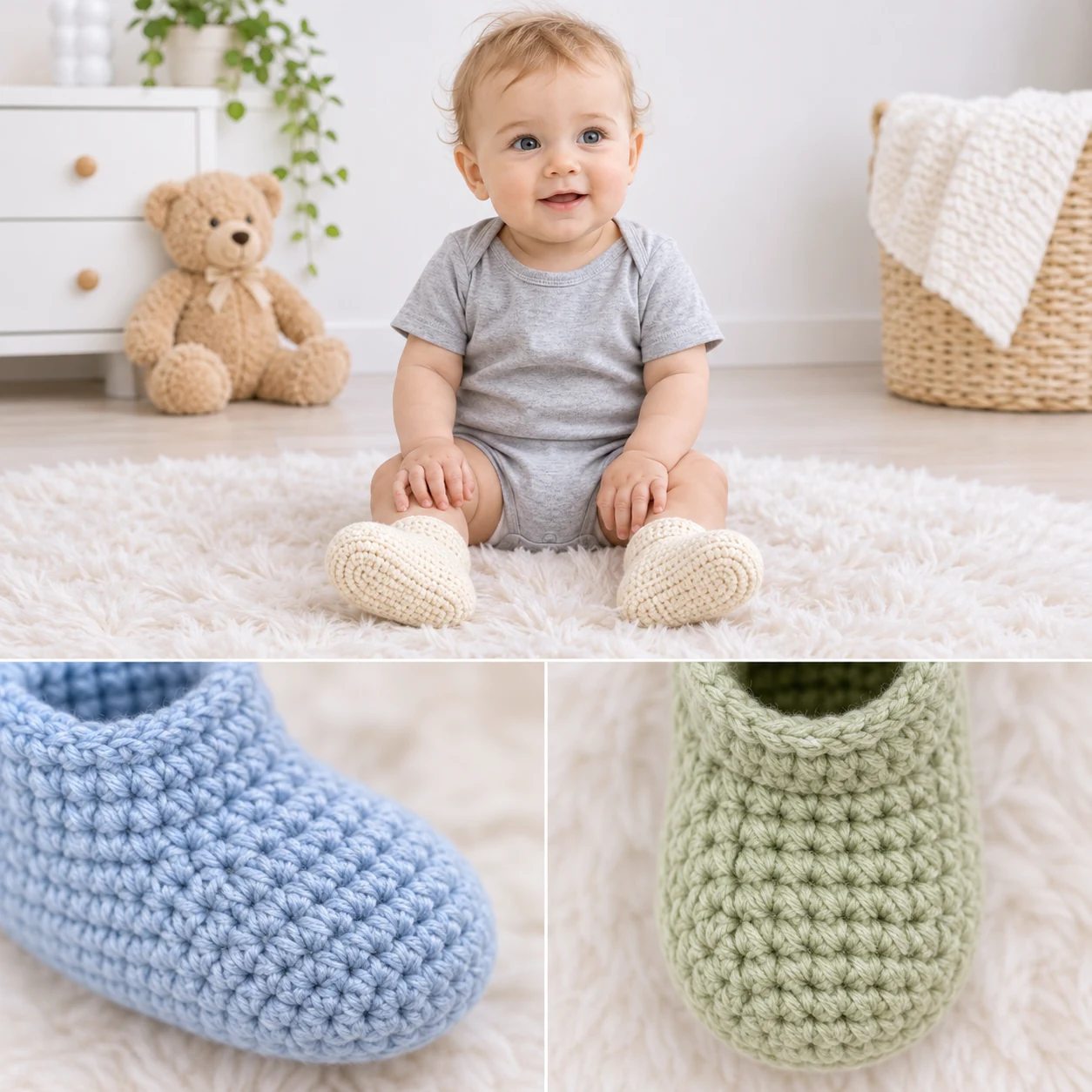
Worked in a soft cream yarn, these booties feature a smooth, dense surface. They rely on the most basic crochet stitch to create a solid fabric that covers the foot evenly.
The single crochet stitch produces a tight weave. This makes the bootie feel sturdy and less open than styles using taller stitches, which helps maintain the shape of the footwear.
For beginners, this style is a great way to practice consistent tension. If the stitches are too tight, the bootie may become rigid, so checking your gauge is important.
When choosing a pattern for this style, check if it is worked in one piece or if the sole is joined to the upper part later to understand the assembly process.
2. Back Loop Only Ribbed Cuff

Crafted in soft blue, these booties feature a textured cuff that resembles knit ribbing. This effect is created by working into the back loop only of the stitch.
The back loop only technique creates raised ridges in the fabric. This makes the cuff stretchy, allowing it to stay on the ankle without being tight against the skin.
Unlike the main body of the bootie, the ribbing provides a different tactile experience and a professional look to the opening of the footwear.
Check your pattern to see if the ribbing is worked separately and sewn on or if it is part of the main body construction to plan your joining method.
Construction Check:
- Check cuff stretch
- Verify join method
- Ensure loose fit
3. Puff Stitch Texture

These booties in pale yellow have a bumpy, three-dimensional surface. This is achieved using the puff stitch throughout the design to create a thick feel.
The puff stitch involves pulling up multiple loops in one stitch before closing it. This creates a soft, raised cluster of yarn that adds significant volume to the fabric.
Because this stitch uses more yarn than a standard single crochet, you may need more materials than you would for a plain style. Check your yarn quantity before starting.
Beginners should be careful not to pull the closing chain too tight, as this can distort the shape of the puff and affect the overall look of the bootie.
4. Shell Stitch Accents

Designed in soft pink, these booties feature decorative fan-like shapes. These are created using the shell stitch, often placed around the ankle or top for visual interest.
A shell is made by working several double crochets into the same stitch. Stitches are commonly skipped on each side, often two, to keep the fabric flat.
This style differs from the puff stitch by creating a flatter, wider decorative element rather than a bumpy cluster, resulting in a different fabric density.
When following a pattern, pay close attention to the skipped stitches to ensure the shells align correctly across the bootie and do not pull the fabric.
5. Lace Mesh Vents

These booties in mint green feature an open, airy look. This is created by alternating double crochet with chain spaces to form a mesh.
The lace or mesh technique results in a lighter fabric. This is a good option for warmer weather when a heavy, solid bootie is not needed for the baby.
This style is distinct from the shell stitch because it creates a grid of holes rather than solid decorative fans, making the overall item more breathable.
It is important to keep the chain spaces small. Gaps that are too loose can catch small fingers or toes, so check the tension of your chains.
Safety Check:
- Inspect for large gaps
- Check for loose threads
- Ensure soft edges
Safety Note: Keep mesh gaps small so little fingers cannot catch in the holes.
6. Tapestry Two-Color Design

Worked in white and blue, these booties feature a patterned look. This is created using tapestry crochet to incorporate two colors into the same row.
In this technique, the unused color is carried inside the stitches. This makes the resulting fabric thicker and firmer than a single-color project.
Because tapestry crochet creates a firmer fabric with less stretch, it is vital to measure the foot carefully and work a gauge swatch.
Keep the design comfortably loose. A rigid fabric that is too small can be restrictive for a baby's foot, so avoid making the fit too tight.
7. Stretchy Ribbed Band Booties

These booties in soft sage green use a stretchy band construction. This ensures the footwear stays on the foot while remaining comfortably loose.
By using stitches that provide flexibility, such as back loop only crochet, the band can expand and contract to accommodate the baby's movements.
This approach is safer for infants than rigid constructions because it avoids gaps and seams that do not stretch, reducing the risk of restriction.
When choosing a pattern for this style, check how the band is integrated into the body to ensure the transition is smooth and secure.
8. Double Crochet Body
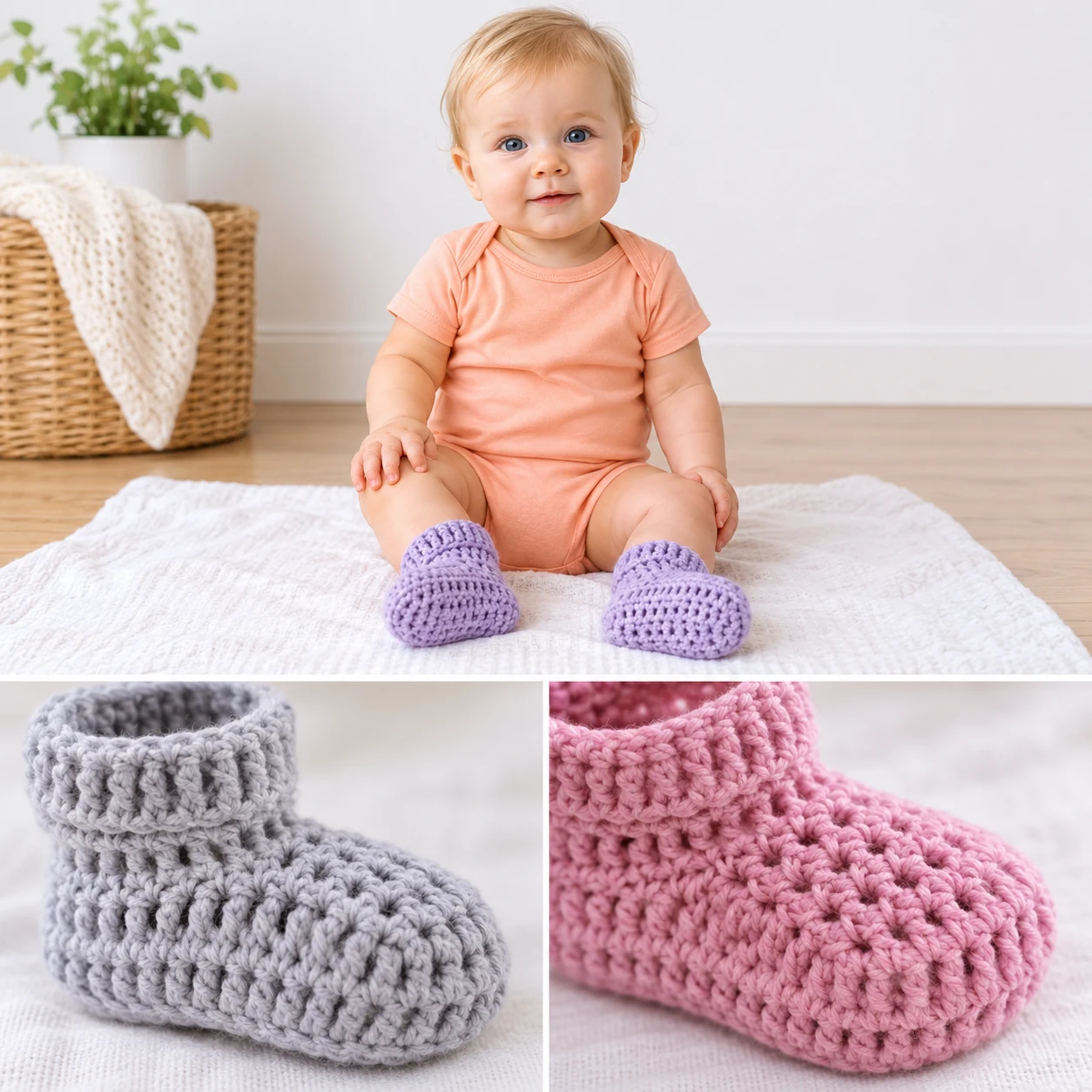
Crafted in lavender, these booties have a slightly taller and softer feel than single crochet versions. This is due to the use of double crochet.
The double crochet stitch creates a fabric that is less dense than single crochet. This often results in a more flexible bootie that grows in size faster during the making process.
This style is a good middle ground for beginners who want a project that progresses quickly but remains simpler than complex shell or puff designs.
Check if your pattern uses a chain 2 or chain 3 for the turning chain, as this affects the height of the edge and the overall fit.
9. Half Double Crochet Texture
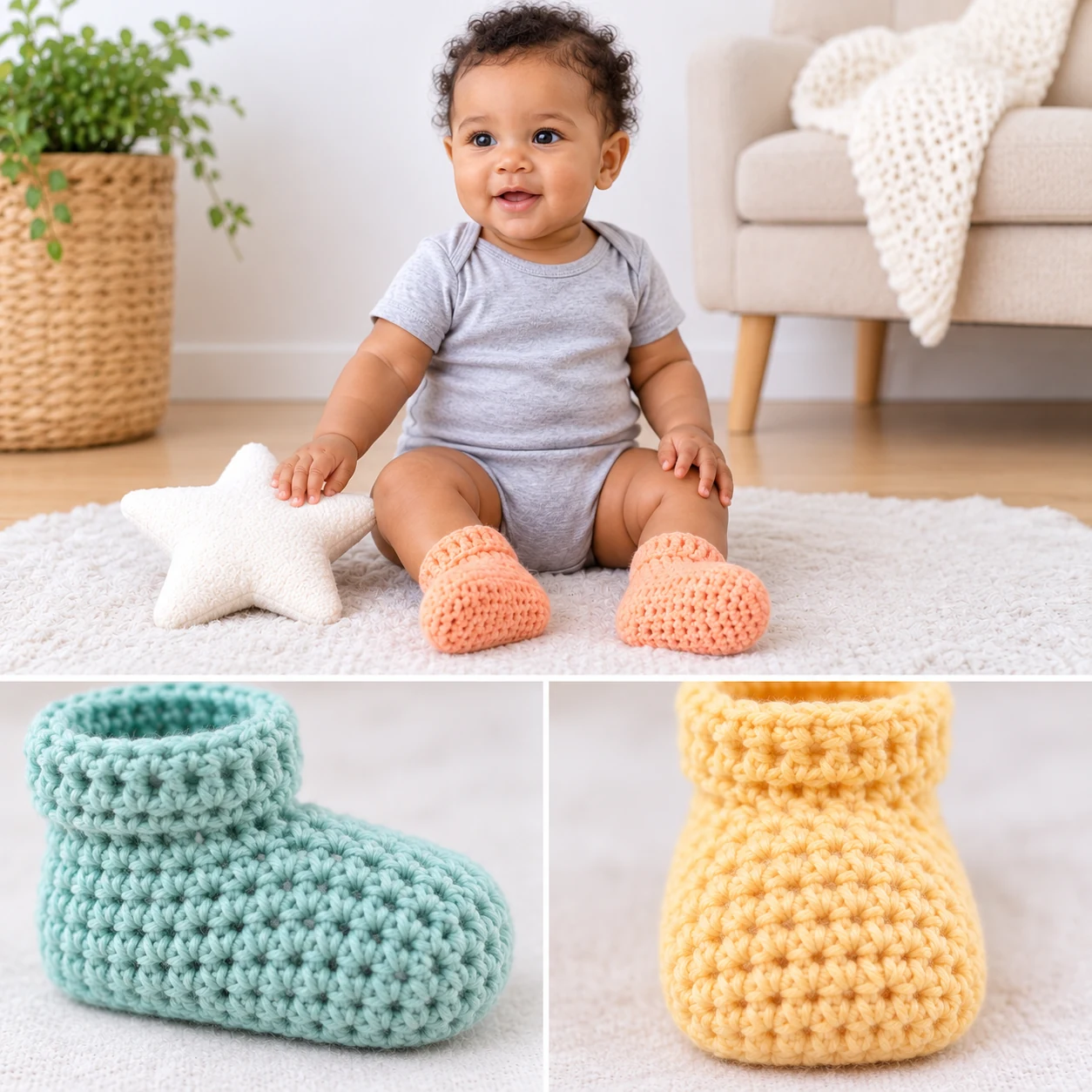
These booties in soft peach offer a balance between the density of single crochet and the height of double crochet.
The half double crochet stitch creates a fabric that is sturdy yet slightly more flexible than a solid single crochet wall, providing a clean look.
This style is often used for the main body of the bootie to provide a consistent texture without creating the large gaps found in lace styles.
When choosing a yarn for this style, consider a soft acrylic or bamboo for a smooth finish that complements the uniform look of the stitch.
Yarn Suggestions:
- Bamboo for drape
- Acrylic for washing
- Cotton for structure
10. Slip Stitch Edged Sole
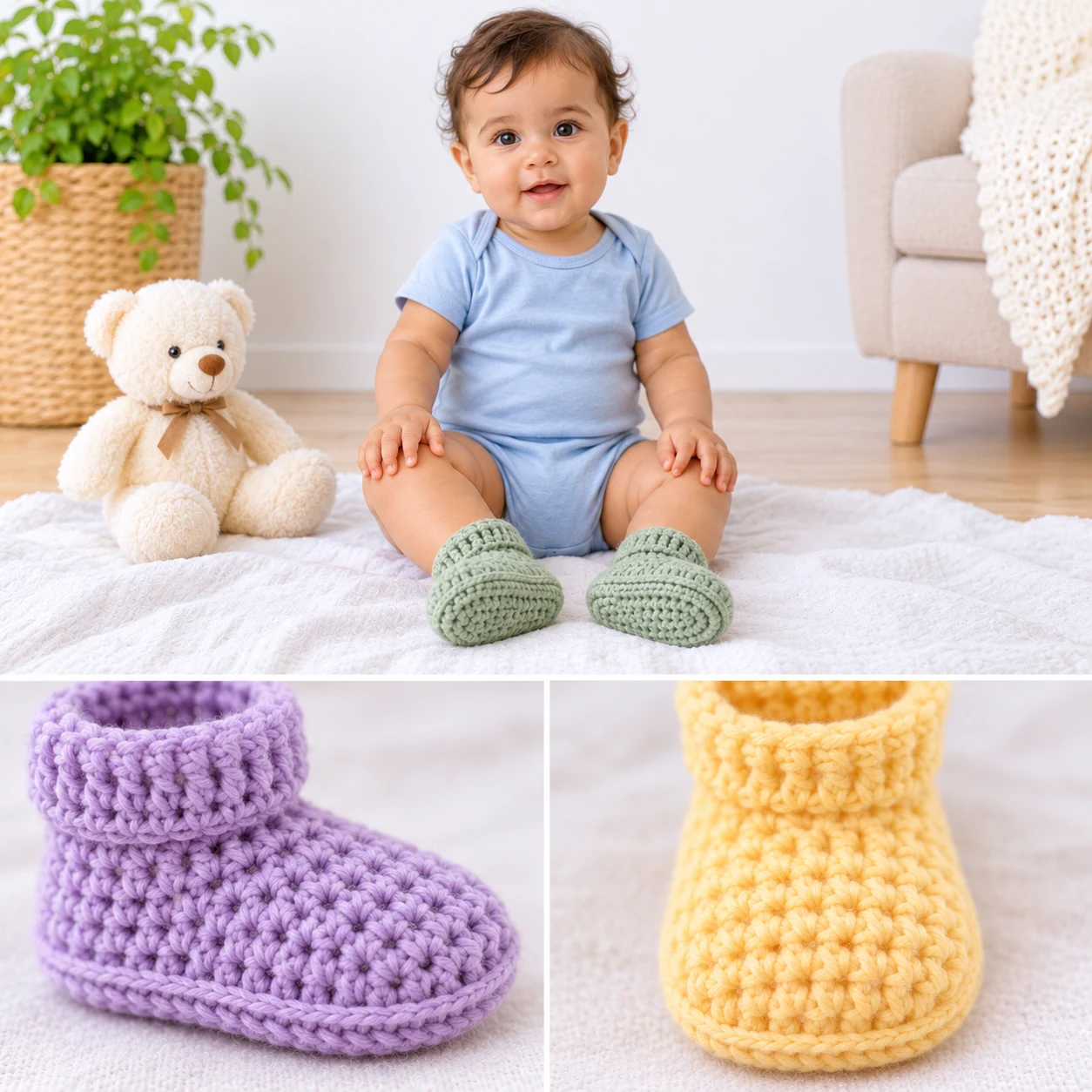
Worked in sage green, these booties feature a clean, reinforced edge around the bottom. This is created using a slip stitch join.
The slip stitch is the shortest crochet stitch and creates a small ridge. This is useful for defining the edge of the sole and adding stability.
This technique is often used to join the upper part of the bootie to the base, providing a clear seam that helps the bootie hold its shape.
Ensure you weave in the ends firmly for several stitches, back and forth, so the seam does not come apart during active use by the baby.
How do I care for crocheted booties?
Proper care ensures that baby booties maintain their shape and softness. Always refer to the yarn label first for specific manufacturer instructions.
At a Glance:
- Follow yarn label
- Lay flat to dry
- Avoid high heat
- Check for loose threads
Avoid using very hot water or high dryer heat, as this can shrink cotton and wool or damage acrylic fibers. Laying the booties flat to dry is the best way to keep their shape.
Regularly inspect the booties for loose threads or snagged hair. If you find a loose loop, carefully weave it back into the fabric.
Care Checklist:
- Wash according to label
- Dry flat
- Inspect seams regularly
- Trim stray fibers
What are common beginner mistakes?
Many beginners struggle with tension, which can make booties too tight or too loose. Working a gauge swatch is the best way to prevent this.
At a Glance:
- Inconsistent tension
- Poorly woven ends
- Incorrect turning chains
- Skipping gauge swatches
Another common error is forgetting to weave in ends securely. If ends are not woven back and forth through several stitches, they can pull out and become a hazard.
Some beginners may also struggle with the turning chain. Using the wrong chain height can leave gaps or create a tight edge at the start of the row.
Mistakes to Avoid:
- Tightening stitches too much
- Using too large a hook for the yarn
- Ignoring the yarn label
- Forgetting to measure the foot
How can I build my skills?
Start with a plain single crochet style to master your tension. Once you feel comfortable, try adding a back loop only cuff to learn how to create stretch.
At a Glance:
- Start with basic stitches
- Practice texture
- Try color changes
- Experiment with assembly
Move on to texture stitches like puffs and shells. These will teach you how to work multiple stitches into one space and how to skip stitches to maintain a flat fabric.
Finally, try tapestry crochet or stretchy bands. These projects will introduce you to color changes and the process of creating a flexible fit for baby wear.
Frequently Asked Questions
Can I use any yarn for baby booties?
You can choose based on your needs. Cotton is breathable, acrylic is easy to wash, wool is warm, and bamboo is soft.
How do I know if the booties are too tight?
Check the baby's skin after they wear the booties. If you see red lines or marks, the item is too tight and should be removed.
What if I don't have a baby to measure?
You can measure a well-fitting shoe or use a gauge swatch to estimate the size based on the pattern's instructions.
Are buttons safe on baby booties?
No, avoid buttons, beads, or any small items that can detach. These can be choking hazards for infants.
Why is my bootie coming out too small?
This is often due to tight tension or using a hook that is too small. Work a gauge swatch and check the yarn label for the recommended hook size.
How do I stop the ends from coming loose?
Weave the yarn ends back and forth through several stitches using a yarn needle. This secures them firmly into the fabric.
Final Thoughts on Baby Booties
Crocheting baby booties is a wonderful way to explore different textures and techniques. By choosing the right yarn and focusing on a comfortable, loose fit, you can create beautiful items for little ones.
Remember that this guide is an overview of styles and techniques. For exact stitch counts, sizing, and assembly, you should always follow a complete, tested pattern.
Always prioritize safety by avoiding small attachments and ensuring the booties are never worn during sleep or left on an unattended baby.